Three Possible Scenarios for a Trump–Lai Phone Call
By Lee Hsiang-chou, China Times Opinion, May 21, 2026
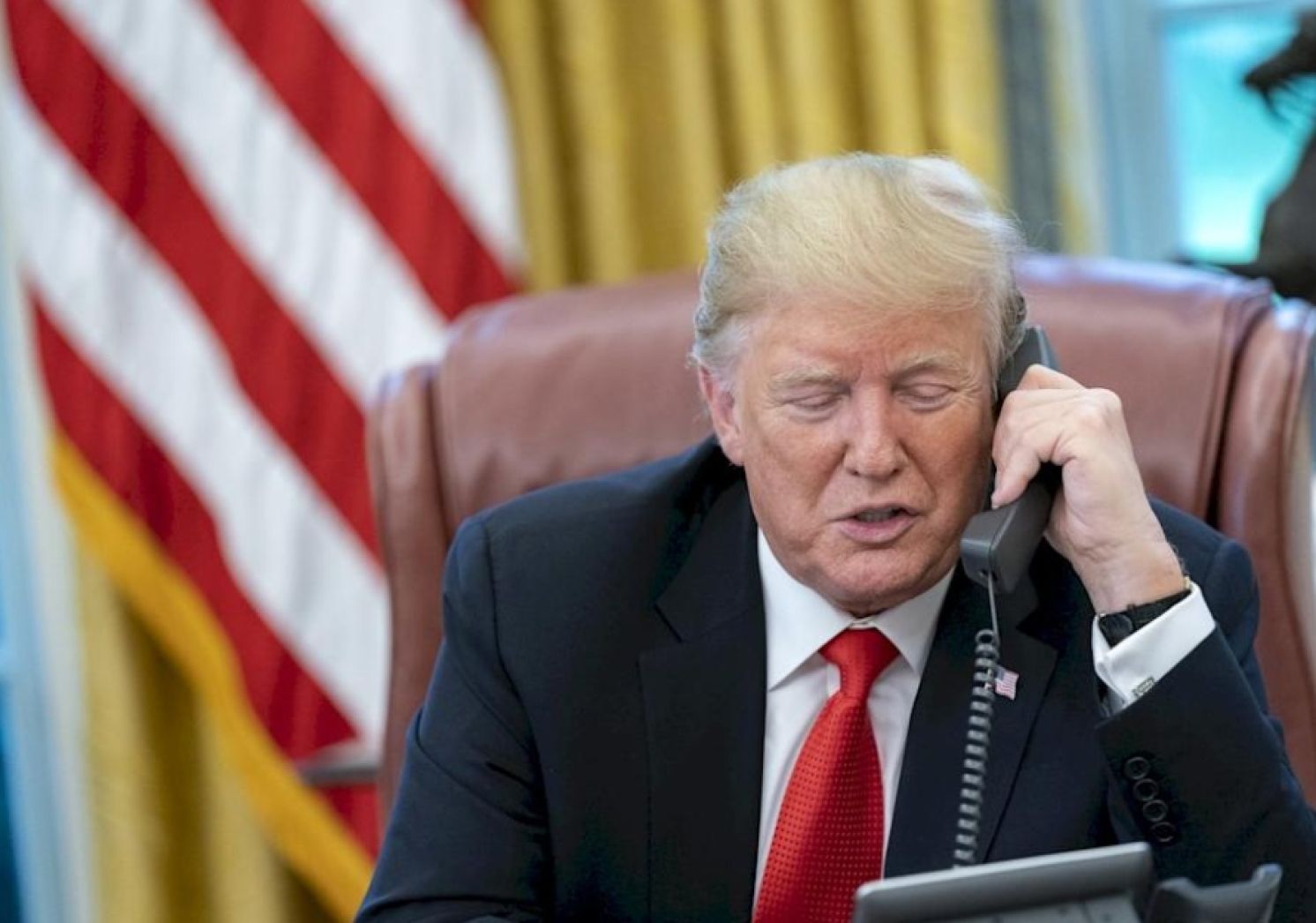
President Donald Trump of the United States publicly confirmed to the media that he plans to hold a direct phone call with President Lai Ching-te. If this indeed takes place, then it would mark the first direct communication between the leaders of the United States and Taiwan since 1979, when Washington shifted diplomatic recognition from Taipei to Beijing. This is the historical significance behind Mr. Trump’s statement.
Mr. Trump announced the planned call with President Lai at a time when his administration is evaluating whether to move forward with an approximately $14 billion arms sale to Taiwan. This potential sale is precisely the key issue that has triggered strong criticism from China.
A phone call between the leaders of Taiwan and the United States would be an extraordinarily powerful political signal. Beijing obtained from Mr. Trump, during the “Trump–Xi meeting,” a statement that he “does not support Taiwan independence.” Yet Mr. Trump’s proactive public announcement of a call with President Lai effectively offsets part of the diplomatic gains Chinese President Xi Jinping believed he had secured from the summit. China will inevitably protest strongly against a Trump–Lai call, but under Mr. Trump’s transactional logic, Beijing’s room for response is actually quite limited.
The Trump administration had previously blocked President Lai from transiting through the United States, drawing criticism as a concession to Beijing. This time, by proactively announcing the call, Mr. Trump is, to some extent, sending a compensatory signal to Taiwan to prevent it from being completely marginalized amid the restructuring of U.S.–China relations.
The Legislative Yuan has already approved $25 billion to advance the pending $14 billion arms sale package as well as the $11 billion package approved last year. The outcome of the Mr. Trump—President Lai call will directly affect Mr. Trump’s final decision, but it may also be used as leverage in negotiations with China.
Mr. Trump once publicly stated that Mr. Xi told him China would not use force against Taiwan during Mr. Trump’s term in office. This remark reveals his underlying framework of thinking: that his own presence is the deterrent variable in the Taiwan Strait. The dangerous implication of this logic is that once Mr. Trump leaves office, the deterrent effect would disappear as well.
Following this line of reasoning, the upcoming call could develop along three possible trajectories. First, pure transactional bargaining: Mr. Trump could use the call to pressure President Lai into increasing Taiwan’s defense budget as a percentage of gross domestic product (GDP), making it a condition for approving the arms sale.
Second, a rebalancing of strategic ambiguity: The call would avoid concrete commitments, but still send Beijing the message that Taiwan remains on Washington’s chessboard, thereby preventing Mr. Xi from misjudging that the United States is fully withdrawing from the Taiwan Strait.
Third, unintended escalation: If President Lai’s wording during the call is interpreted by Beijing as provocative, or if Mr. Trump’s public remarks afterward break beyond the framework of the “One China” policy, then China could adopt confrontational measures such as military exercises or economic pressure, sharply escalating tensions in the Taiwan Strait.
Worthy to note is that the 2026 National Defense Strategy (NDS) adjusted military priorities toward homeland defense, dominance in the Western Hemisphere, and deterring China in the Indo-Pacific, while requiring allies to shoulder more of the burden. Yet in the document, the word “Taiwan” does not appear even once.
This deliberate textual omission does not signify abandoning Taiwan but rather a carefully calculated form of strategic ambiguity. It is an intentionally designed dual-track structure: ambiguity towards Beijing in strategic documents, clarity toward Taipei through arms sales actions. Concessions in rhetoric, but not in substance.
Thus, the logic of a U.S.–Taiwan leaders’ call is not difficult to understand as “killing multiple birds with one stone.” The first bird: maintaining Taiwan’s strategic value within the first island chain. The second bird: fulfilling the promise made to Mr. Xi to “oppose Taiwan independence.” The third bird: using Taiwan as leverage to obtain other concessions from China.
Mr. Trump’s Taiwan policy can be summarized in one sentence: Give Taiwan enough capability so that China does not dare attack but not enough confidence for Taiwan to provoke China. There is a cold rationality to this logic at the strategic level, and it does help maintain the status quo. Yet it also means that Taiwan’s fate is not determined by the Taiwanese people themselves but jointly managed by two superpowers at the negotiating table.
On the second anniversary of his inauguration, President Lai said, “Taiwan’s future can only be decided by the Taiwanese people themselves.” This statement is both a political declaration and a self-reaction against the role of being a chess piece. Yet the gulf between declaration and reality is precisely Taiwan’s deepest strategic anxiety.
(The author is former director-general of the National Security Bureau.)
From: https://www.chinatimes.com/opinion/20260521004209-262104?chdtv